Summer absolutely flew by—and honestly, in Santa Barbara it still feels like summer! If you've lived here long enough, you know August through October can bring some of our best weather of the year. ☀️
Our kids are at Montecito Academy, so while it seems like everyone else is heading back to school, we still have a few more weeks with them basically full-time.
My wife and I did manage to sneak away for a couple of days to celebrate our 16th anniversary—sans children! It was a wonderful opportunity to spend time together and reconnect. We may have made the kids a little jealous by spending an entire day at Disneyland without them. 😬 We rope-dropped the park and stayed until they practically kicked us out. (Full disclosure: there was a midday hotel nap and pool break. We're not 20 anymore. 😂)
Meanwhile, the boys are jumping right back into sports with soccer, soccer, more soccer ⚽… and a little flag football mixed in. 🏈
The season definitely feels like it's changing.
And I think the real estate market may be changing with it.
🏡 Is the Market Shifting?
Homes are still selling. Great homes are still selling quickly, and some are still going over asking.
But the market feels different.
For a long time, we had a strong seller's market. Then we entered what I've called a "tale of two markets"—some properties receiving multiple offers while others sat.
Now, it feels like another change may be coming.
📊 July's numbers:
🏡 187 homes sold — almost 30 more than last year 💰 Median sales price: $1,462,000 — about 1.5% lower than 12 months ago 📉 Months of inventory: 3.64 — down 18.75%
Typically, anything below four months of inventory still favors sellers. So while pricing has softened slightly year-over-year, supply and demand still point toward a seller's market.
That's what makes today's market so interesting.
Buyers Want Two Things 👀
1️⃣ Opportunity & Excitement
Today's buyers are savvy. They have access to more information than ever, and many have already missed out on at least one home—sometimes several.
They recognize a great opportunity when they see one.
2️⃣ The Right Price
Pricing creates excitement.
When buyers see a property and immediately think, "That's a good deal," they know someone else is probably thinking the exact same thing.
That's when we see urgency, competition, and sometimes multiple offers.
For sellers, the lesson is simple: don't price your home based on what you hope someone will pay. Price it strategically enough to make buyers want to compete for it.
As we head into Santa Barbara's "Secret Summer" and the fall real estate market, I'll be watching closely to see whether this shift continues.
If you're considering buying or selling, let's talk about what these numbers actually mean for your home, your neighborhood, and your goals.
Enjoy the rest of summer! ☀️🏡
— Justin Etherton Real Estate Group
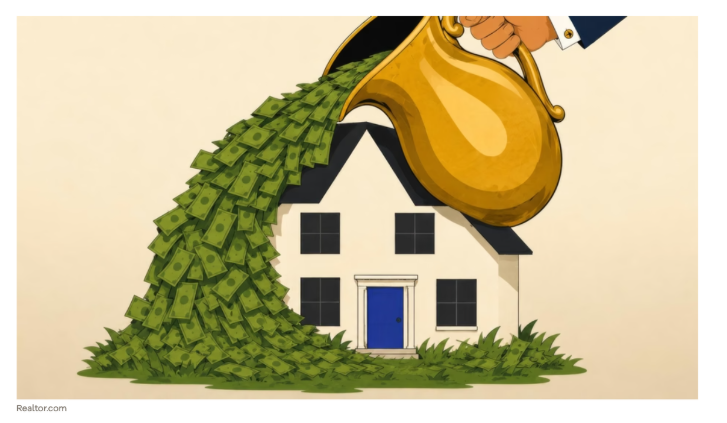
Why Big Banks Are Pouring Billions Into Reviving the Housing Market By Tristan Navera
Realtor.com
JPMorgan Chase, the nation's largest bank, is a name typically attached to big numbers. But a new plan to invest $750 billion into housing market initiatives in the next decade stands out.
The bank announced this summer it would deploy $750 billion into the housing market through 2035. Its "American Dream Initiative" aims to build or preserve 1 million affordable housing units and help 500,000 customers purchase homes, 200,000 of them for the first time.
It's not alone. Wells Fargo, Citibank, and Bank of America—which, with JPMorgan, comprise the "big four" of American finance—have each announced major housing initiatives. And, like the $5 trillion JPMorgan Chase, they're directing tens of billions toward the problem.
The nationwide housing supply shortage, as well as rampant pessimism among young people, make the issue too big to ignore, says Sam Sheets, a strategy executive for Community & Affordable Lending at JPMorgan Chase.
"At the end of the day, it's a function of supply and demand," Sheets says. "Supply is the big issue—and supply of homes at the right price point."
Housing has long been a major focus for banks. Bank of America, for instance, has provided $15 billion in loans and grants since 2019 to support down payments, closing costs, and affordable mortgage options for homebuyers. It partners with 300 housing counseling groups in the process.
But banks are now also expanding their support for efforts like zoning reform, building code changes, and new homebuilding in an effort to restore affordability to the housing market—and potentially expand the pool of mortgage borrowers, which has been shrinking lately.
"It's driven by slower new construction but also just a lock-in effect, which has forced families to stay put when they would have moved and upsized," Sheets says.
The business case for bank intervention
Reading between the lines, banks may be concerned about the decline in mortgage business in recent years. The number of mortgage originations at large banks has hovered below 500,000 for the past three years, well below the million-plus levels typically seen before the pandemic, according to tracking from the Philadelphia Fed.
The sharp drop-off in big bank mortgages is due in part to increased competition from specialty lenders, but the main culprit may be the overall decline in homebuying activity since 2022.
Bernard Nossuli, COO at lending data company iEmergent, notes the mortgage business has been racked by the uncertain market, including high interest rates and limited signals from the Federal Reserve about when that might change.
.Roughly 581,000 home purchase loans were originated from January through March 2026, down 19% from the previous quarter and a 12-year low. With many younger buyers priced out, and older buyers "locked in" to homes with low rates, supply-side solutions seem to be the easiest lever to pull right now.
But while those policies might seem straightforward, "the reality is a lot more complicated than that," Nossuli says
9 of the Best Small U.S. Cities to Move to Right Now, According to Real Estate Experts
From Rhode Island to Washington, these small cities are drawing buyers with strong value, lifestyle perks, and staying power.
www.TravelandLeisure.com By Lydia Mansel
When it comes to moving to a new destination, it may sometimes seem like you have only two choices: either pick a large city or settle down in a sleepy small town. But the reality is, there are hundreds of smaller cities—which we define as those with populations between around 25,000 and 100,000—with tight-knit communities, well-rounded amenities, and relatively affordable real estate markets.
“When evaluating the best small cities to live in and own real estate, I look for a strong job market, safe and desirable neighborhoods, ample access to outdoor activities, and demand to allow for continual improvement, yet never lose the charm of the city,” says Brett Johnson, a Colorado real estate investor and founder of New Era Home Buyers. Below, Johnson and real estate experts from across the United States share their top picks for the best small cities to call home.
01of 09
Caldwell, Idaho
A pedestrian bridge in downtown Caldwell, Idaho.
MaloryKelina/Adobe Stock
The Boise metropolitan area has seen a steady increase in population as of late—and Jordan Del Palacio, a Washington-based home loan specialist with Churchill Mortgage, says the growth is also “starting to trickle out to the western suburbs,” including Caldwell. “Homes in Caldwell are priced less than Boise proper, with new construction being built and sold for reasonable prices,” he says. “Traffic is generally low in the metro, and everything from downtown to the airport is a reasonable drive. Additionally, there have been major business investments in the area, such as the semiconductor industry, which provides good, higher-paying jobs relative to the area’s cost of living.”
The average home value in the city is about $400,000—about $100,000 less than Boise. “Combining this with the property tax break you get for making this your primary residence, this is an affordable area to live that should grow and improve over the next 10 years,” he adds.
02of 09
Roswell, Georgia
Al fresco sidewalk cafes in Roswell, Georgia.
Jeffrey Greenberg/Universal Images Group via Getty Images
If Atlanta feels too big and busy for your taste—but you still want a somewhat comparable lifestyle—you may enjoy Roswell, Georgia. “Roswell stands out for its blend of historic character and modern energy just outside Atlanta. Its walkable downtown is anchored by local restaurants, shops, and preserved architecture that give the city a strong sense of identity,” says Amy Nease, a global real estate advisor with Premier Sotheby’s International Realty. “Outdoor access along the Chattahoochee River adds to its appeal, offering a balance of nature and community. It’s ideal for those seeking connection, convenience, and a vibrant local culture.”
Roswell’s appeal is far from under the radar, though. Its location, top-rated schools, and high quality of life fuel the real estate market. According to Zillow, the average home value in Roswell is about $660,000.
03of 09
Longmont, Colorado
The Longmont Golf Course in Longmont, Colorado.
Jon Camrud/Adobe Stock
“One of the best-balanced small cities I see right now is Longmont, Colorado. It has a great job base, good schools, two hospitals, and over 90 miles of trails,” says Johnson. “Longmont is a very practical and active place to live with a Boulder County address, without the higher-than-necessary housing costs that are required in the city of Boulder. Places with real jobs and lifestyle value tend to hold value very well.” Longmont, population just over 100,000, has an average home value of around $550,000. Boulder, a 30-minute drive away, has an average home value of over $950,000.
04of 09
Newport, Rhode Island
Storefronts in Newport, Rhode Island.
Violetta Smirnova/Travel + Leisure
Newport, Rhode Island, is a small New England city with prestige, glamour, and nautical heritage—making it an incredibly picturesque place to call home. “Families get a mix of history and coastal living. It’s walkable, so that is a benefit, especially with kids,” says Katy McBrayer-Lynch, global real estate advisor at Premier Sotheby’s International Realty. “There’s also something about the changing of the seasons here that people love. Coming from a Florida perspective, it gives the year a rhythm you don’t always get in warmer places.” It might be one of the best small cities in the U.S., but it’s not the cheapest. Payscale estimates the cost of living in Newport is 29 percent higher than the national average.
Google Buys 83,000-Square-Foot Campus in Goleta for $32.5M
Independent By Izadora Hamm
Purchase Expands Tech Giant’s Existing Footprint in City, Where It Operates Quantum AI Lab
Google’s Goleta footprint is expanding.
On August 5, Hayes Commercial Group, a Santa Barbara–based commercial real estate brokerage, reported that the tech giant had purchased an 83,356-square-foot campus spanning 147 and 153 Castilian Drive, near the intersection of Los Carneros Road and Hollister Avenue, for $32.5 million.
The purchase adds to Google’s existing presence in Goleta, bringing its current footprint to approximately 300,000 square feet, according to Hayes Commercial Group.
The two-building property sits on roughly five acres at the entrance to Santa Barbara Research Park, an R&D and technology corridor that is home to aerospace, defense and technology companies, according to Commercial Property Executive, a news and digital media outlet covering the U.S. commercial real estate industry.
Less than a mile from the newly acquired property, Google also leases space at 6868 Cortona Drive and operates a Quantum AI lab at 301 Mentor Drive — both locations are connected to Google’s work with UC Santa Barbara on quantum computing research, Commercial Property Executive reported.
According to Google, quantum computers use quantum bits, or qubits, rather than the traditional bits used by classical computers. While a classical bit represents either zero or one, a qubit can exist in a combination of both states.
Google says the technology could eventually allow computers to tackle certain problems exponentially faster than classical computers.
Google’s Quantum AI campus in Santa Barbara brings together research, quantum hardware development, and a fabrication facility as the company works toward building large-scale, error-corrected quantum computers, according to Google.
The deal adds to Google’s growing presence in Goleta, strengthening its foothold in a city that has long been home to research, technology, and innovation.
When will mortgage rates go down? As the selling season closes, not soon enough.
Yahoo Finance E. Napoletano Hal Bundrick
Mortgage rates have stymied the 2026 housing market, with year-over-year purchase volume down 3.4%, according to an analysis by investment bank Keefe, Bruyette & Woods. What will it take for mortgage rates to move lower as the bond market continues to boil?
Are mortgage rates dropping?
As of August 20, Freddie Mac reported that the average 30-year fixed-rate mortgage rate was 6.65%. This is two basis points lower than last week. At this time in July 2025, mortgage rates averaged 6.58%, seven basis points lower
The average 15-year fixed mortgage rate this week was 5.95%, down one basis point from last week, and 26 basis points higher than this time last year.
Here's the Freddie Mac data on mortgage rates for the past 52 weeks as of August 13, 2026:
30-year fixed-rate mortgage: 5.98% to 6.69%
15-year fixed-rate mortgage: 5.35% to 6.04%
Will mortgage rates trend down by the end of 2026?
Mortgage rates generally move in unison with the bond market. The 10-year Treasury yield has steadily risen over the past month, and home loan rates are mirroring that momentum.
KBW managing director Bose George believes higher mortgage rates will continue to pressure the housing market.
"We think [mortgage application] volumes will continue to be weak given the recent increase in mortgage rates, which is likely to keep refinance activity low while purchase is slowing both on higher rates and seasonality, as the selling season winds down," George said in a report to clients.
Fannie Mae's August forecast projects mortgage rates to remain in the 6.8% range through 2027.
The Fed is unlikely to play a role this year
The Federal Reserve lowered the fed funds rate three times in 2025, but the central bank has been on hold so far in 2026, including its most recent meeting on July 29. So, what does this mean for mortgage rates through the end of the year?
That federal funds rate tends to directly influence rates on shorter-term lending. While mortgage rates aren't directly based on the fed funds rate, they typically mirror fed funds rate trends. So, if the fed funds rate goes up, mortgage rates will likely follow. The inverse is also true.
The Fed — the common nickname for the Federal Open Market Committee (FOMC) — has a new chairman, Kevin Warsh, but the same game plan: keep rates unchanged for now. At this point, Wall Street traders aren't expecting a quarter-point interest rate hike until December at the earliest.
Congratulations to my amazing client Rashid. After months of searching we were able to get you into a fantastic new construction in Lompoc. The new construction process is completely different than the resale market but there are certain things one can do to get you a better deal and help protect you as a buyer. Rashid you were amazing to work with and I am so excited for you.
What My Clients Are Saying
Want Off Market Properties?
See all the current properties that are not yet on the market. Send us an email and we can start sending you these properties daily. Or ask us about our growing list of off market sellers.
We have a property on the Mesa and Los Carneros Village that will be coming soon. Call us for more details.
Local Market Insights This Month!
New Listings
252 homes hit the market in July
Turn Over
Anything under 4 months of inventory is considered a sellers market.
DOM The average home is taking about 65 days to sell in July.
You're one step away from getting a free marketing plan that shows how we'll sell your home for the most amount of money in the least amount of time - hassle free.


:max_bytes(150000):strip_icc():format(webp)/TAL-caldwell-idaho-LIVESMTWNUS0626-e85249b960764ce1afbbe74b4593f00b.jpg)
:max_bytes(150000):strip_icc():format(webp)/TAL-roswell-georgia-LIVESMTWNUS0626-05d6ff5e64dd495ba1b6f911489a68d7.jpg)
:max_bytes(150000):strip_icc():format(webp)/TAL-longmont-colorado-LIVESMTWNUS0626-685af1934c8146a988daa9e5dcec1f63.jpg)
:max_bytes(150000):strip_icc():format(webp)/TAL-newport-rhode-island-LIVESMTWNUS0626-911a657306994d95849d59edcfc93e2d.jpg)